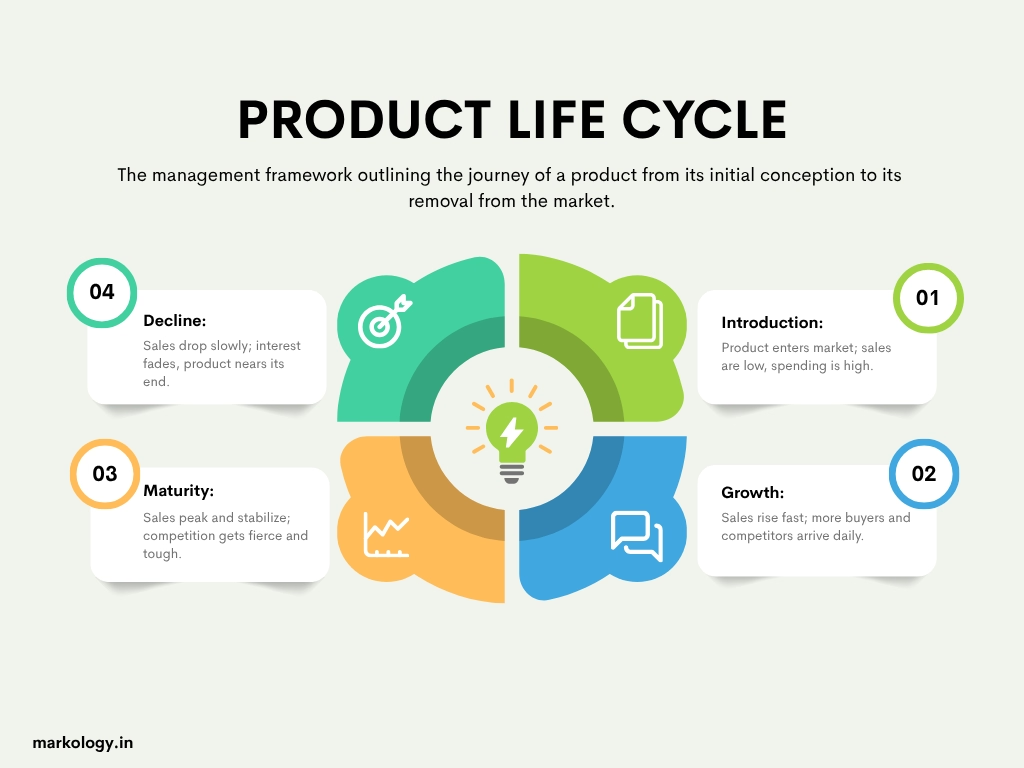

Imagine you plant a seed. First, nothing happens for a while. Then a tiny sprout appears. It grows tall and strong. It flowers and stays beautiful for a long time. And eventually, it starts to wilt. Every living thing follows a journey like this, and so does every product we buy.
In marketing, this journey is called the Product Life Cycle (PLC). It explains how a product is born, grows up, becomes popular, and sometimes fades away. Smart companies study this cycle so they can make the right decisions at the right time.
The 4 Stages of a Product’s Life
Stage 1: Introduction This is when a product is born and enters the market for the first time. Sales are usually very low because not many people know about it yet. Companies spend a lot of money on advertising to tell people the product even exists. Profits are mostly zero or even negative at this point.
Stage 2: Growth Word spreads! More and more people start buying the product. Sales shoot up quickly, profits start coming in, and competitors notice. They start launching their own similar products to grab a share of the growing market.
Stage 3: Maturity This is the busiest and longest stage. Almost everyone who wants the product already has it, so sales stop growing as fast. Competition is fierce. Companies try to hold on to their customers by improving the product, offering new versions, or dropping prices.
Stage 4: Decline Slowly, people lose interest. Maybe a better product has come along, or tastes have simply changed. Sales drop. Some companies choose to stop the product. Others try to refresh it and extend its life.
Real-World Example:
Example 1: Reliance Jio (Telecom Services)
Jio is one of the best examples of the Product Life Cycle playing out right in front of our eyes.
Introduction (2016): Jio launched its commercial services in 2016, providing free data and voice calls as its opening strategy. Within just the first month, Jio had acquired 1.6 crore (16 million) subscribers, and it crossed 5 crore (50 million) subscribers in 83 days since launch. No product in telecom history had ever grown this fast in India.
Growth (2017 onwards): Jio crossed 100 million subscribers by February 2017, and by October 2017 it had about 130 million subscribers. The whole country was talking about it. Competitors like Airtel, Vodafone, and Idea were scrambling to respond.
Maturity (Present): Today, Jio has settled into the maturity stage in a commanding position. By September 2025, Jio had surpassed 500 million subscribers. Its revenue from operations climbed 14.6% year-on-year to Rs. 36,332 crore. To stay competitive and extend its life cycle, Jio is now pushing into 5G, home broadband, and AI-powered apps.
The lesson: Jio used bold, aggressive pricing during the Introduction and Growth stages, then evolved into a full digital ecosystem to remain strong in Maturity.
Example 2: Maggi Noodles (Nestle India)
Maggi is a story about how a product can go through the full cycle, hit an unexpected crash, and then fight its way back.
Introduction (1982): Nestle launched Maggi noodles in India in 1982, targeting busy working mothers and children who needed a quick meal. Sales were slow initially because Indians were not familiar with instant noodles.
Growth and Maturity: Over the next two decades, Maggi became a household staple. By 2015, Maggi’s market share had reached 63% in India’s instant noodles market, a sign of deep maturity.
Decline (2015): A sudden crisis hit. In June 2015, Maggi was banned across India after the Food and Drug Administration found much higher than permissible amounts of lead in samples. The company had to recall 38,000 tonnes of Maggi noodles from millions of retail shelves across the country. Nestle’s net profit for the year fell to Rs. 563 crore from Rs. 1,185 crore, and Nestle took a hit of Rs. 450 crore as it destroyed over 30,000 tonnes of Maggi.
Revival: But Nestle refused to let Maggi die. They fixed the product, relaunched it on Diwali 2015, ran emotional campaigns, and rebuilt trust. Market share by volume, which was zero immediately after the ban, climbed to 10% in November 2015, 33.3% in December, 42% in January 2016, and 48% by February 2016. By mid-2016, it had risen to 60% market share, and the company reported a turnover of approximately US$1.4 billion in 2016, up almost 13% over 2015.
The lesson: Even products in decline can be revived. Nestle used honest communication and product fixes to pull Maggi back from a complete collapse.
Conclusion
The Product Life Cycle is like a GPS for businesses. Knowing which stage their product is in helps them decide:
- How much to spend on advertising
- Whether to lower prices or launch new versions
- When to invest in the next big product
Whether it’s a telecom service like Jio or a bowl of noodles like Maggi, every product has a story. And that story always follows the same four-chapter journey.
Leave a Reply