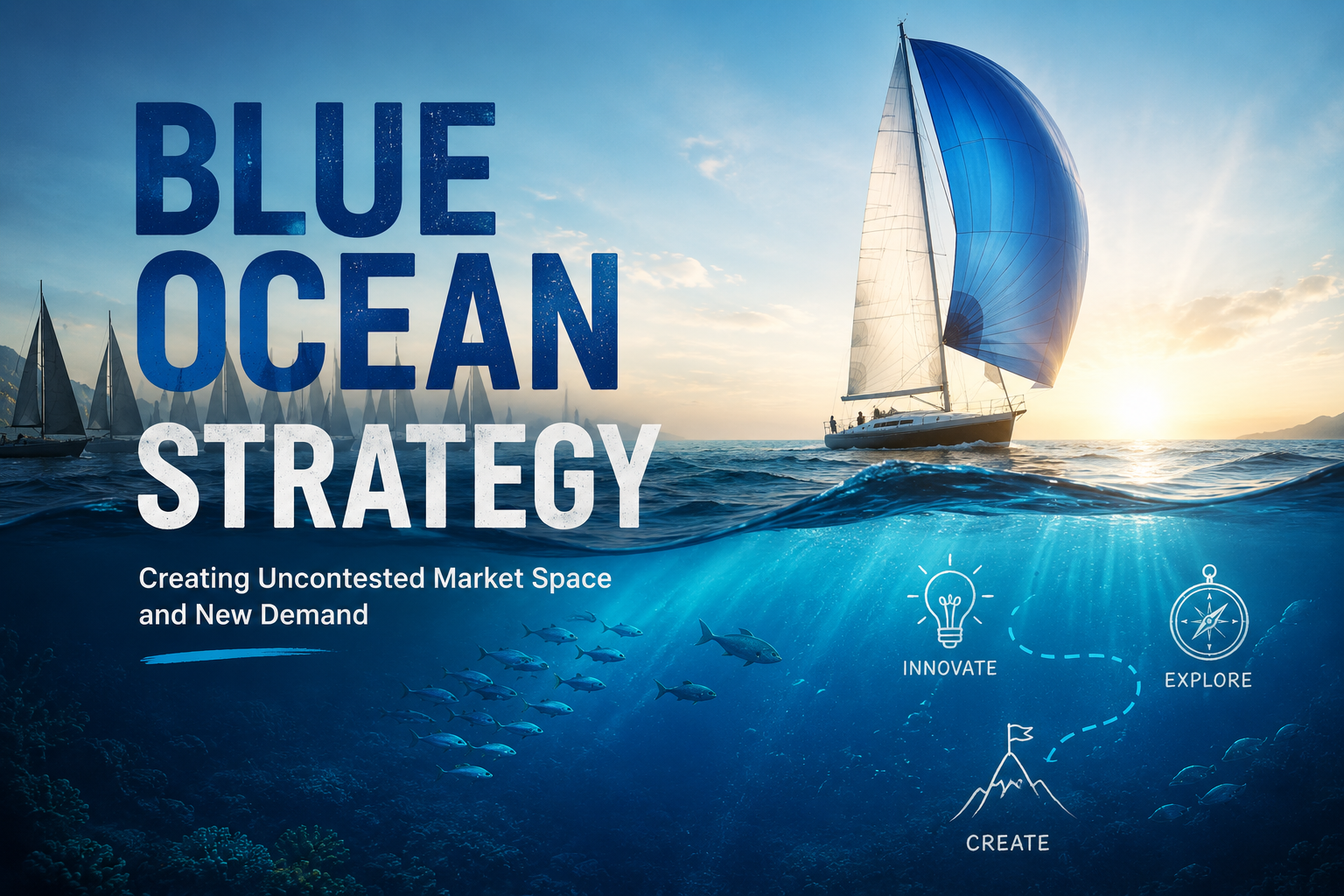

Blue Ocean Strategy was formally introduced by W. Chan Kim and Renee Mauborgne, professors at INSEAD Business School, through their landmark 2004 paper in Harvard Business Review and their subsequent 2005 book of the same name.
According to Kim and Mauborgne, Blue Ocean Strategy is defined as the simultaneous pursuit of differentiation and low cost to open up a new market space and create new demand. It is about creating and capturing uncontested market space, thereby making the competition irrelevant.
The Blue Ocean, by contrast, is defined by untapped market space, demand creation, and the opportunity for highly profitable growth.
Think about the food delivery market in India in 2018. Every app, Swiggy, Zomato, Foodpanda, was fighting to deliver from the same restaurants to the same customers in the same cities. Price wars, discount battles, app notifications at 12 AM. That is a red ocean. Everyone is fishing in the same water and the water is turning bloody.
Blue Ocean Strategy is essentially this: instead of dividing up existing demand, go find or create demand that nobody has claimed yet.
Success Story: Zepto (India)
Zepto was founded in 2021 by Aadit Palicha and Kaivalya Vohra, two Stanford dropouts who were 19 years old at the time. When they entered the market, quick commerce as a concept existed but delivery in under 10 minutes did not. Swiggy Instamart and Blinkit were operating on 30 to 45 minute delivery windows. Zepto did not try to compete by being cheaper or having more restaurants. It carved out an entirely new value proposition: 10-minute grocery delivery through a dark store network.
This was a textbook blue ocean move. It created a new category of consumer behaviour, the impulsive, no-planning-required grocery purchase. Customers who never planned grocery runs 30 minutes ahead could now order because 10 minutes fit into any gap in their day.The brand did not win by being better at what others were doing. It won by doing something others had not yet defined as a market.
Failure Story: Byju’s International Expansion
Byju’s, which scaled aggressively in the Indian edtech market post-2019, attempted to replicate a similar blue ocean logic in international markets, particularly the United States and Europe, by positioning itself as premium, personalised learning for K-12 students.
The theory was sound: traditional tutoring was expensive and unscalable, and digital personalised learning was an underexplored space in those markets.
However, the execution failed because Byju’s misread what made a blue ocean opportunity viable in a new geography. The US market had established alternatives including Khan Academy for free self-paced learning and well-funded players like Chegg and Varsity Tutors for paid tutoring.
The cultural trust framework for purchasing digital learning for children was also fundamentally different from India. Byju’s attempted to plant a blue ocean flag in territory that was already either occupied or where demand simply did not exist in the form they assumed.
A blue ocean strategy fails when the brand mistakes an underserved market for a non-existent one and does not validate demand before scaling.
Blue Ocean’s Core Tool: ERRC
Kim and Mauborgne introduced the Eliminate-Reduce-Raise-Create (ERRC) grid as the practical tool for executing a Blue Ocean Strategy. It asks four questions that force a brand to rethink its value proposition from the ground up.
- Eliminate: Which factors that the industry takes for granted should be eliminated? These are factors that add cost but no longer create value for the customer.
- Reduce: Which factors should be reduced well below the industry standard? Not removed, but brought down to free up resources and simplify the offering.
- Raise: Which factors should be raised well above the industry standard? These are the areas where the brand bets on outperforming existing norms.
- Create: Which factors should be created that the industry has never offered? This is where new demand is born.
Zepto’s ERRC grid would look something like this: Eliminate wide product assortment (early stage); Reduce delivery time window from 30-45 minutes to 10 minutes; Raise reliability and inventory accuracy; Create the dark store model for hyper-proximity to the consumer.
This grid is what separates Blue Ocean Strategy from generic differentiation. It is not just about being different. It is about being different in a way that simultaneously creates value for the customer and lowers cost for the company.
Blue Ocean Strategy Adoption
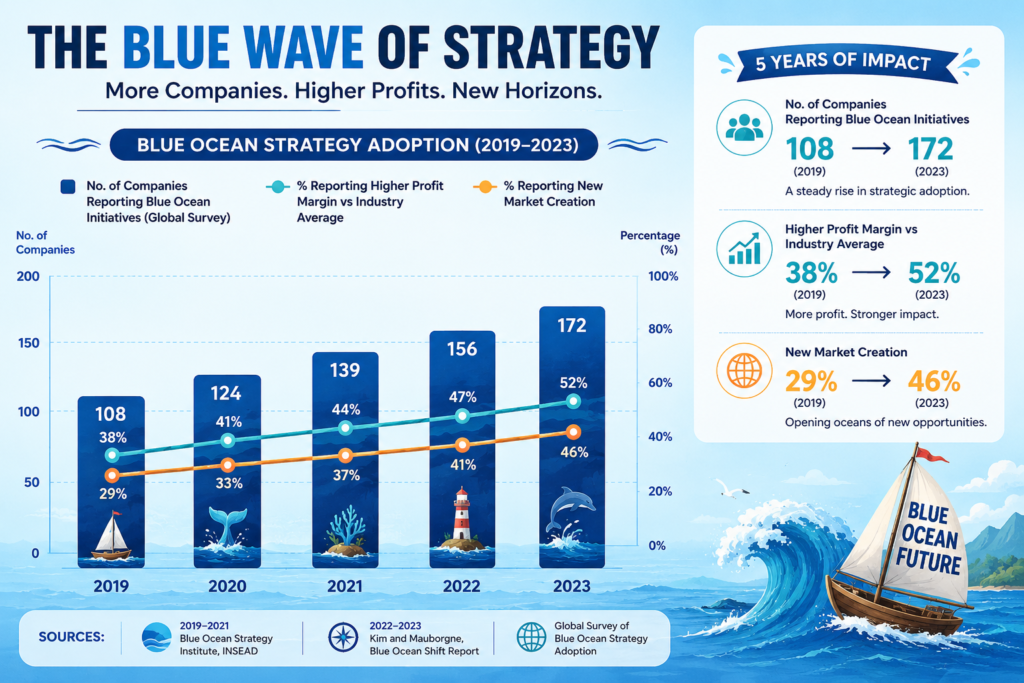
Additionally, a 2022 study published in the Journal of Business Strategy analysed 150 companies across 30 industries and found that firms applying blue ocean principles reported an average revenue growth rate of 22% higher than industry peers over a five-year period, compared to 8% for companies competing within existing market boundaries.
Conclusion
It is a structured thinking framework that asks a simple but uncomfortable question: are you competing for existing customers or creating new ones? In a market environment where most categories in India and globally are getting more crowded, more commoditised, and more driven by discount warfare, the brands that grow fastest are the ones that find space where no one else is playing yet.
The challenge is having the discipline to stop looking sideways at competitors and start looking outward at what customers need but cannot yet find.
Leave a Reply