
Ale Smidts, Professor of Marketing Research at Erasmus University Rotterdam, introduced the term neuromarketing in 2002. He defined it as the use of brain-scanning methods to measure a consumer’s response to marketing stimuli, in order to improve marketing effectiveness.
Scholars later expanded this definition. Neuromarketing involves studying brain activity and physiological responses. It reveals how consumers make decisions, often beyond their conscious awareness. Neuroscientific methods measure, map, and record brain and neural activity during consumer behavior.
Read Montague, Professor of Neuroscience at Baylor College of Medicine, conducted the first scholarly neuromarketing research in 2003. It was published in Neuron in 2004 and became widely known as the Pepsi versus Coke experiment. That study shifted marketing research toward the non-rational, emotionally driven side of consumer decision-making.
What Neuromarketing Actually Means
Think about the last time you scrolled through an online food ordering app. You did not read every item. Your eyes jumped to certain photos. A few words stood out. One image made you feel something. Within 90 seconds, you placed an order you had not planned.
No survey could have predicted that. No focus group would have caught it. You probably could not explain it yourself.
Neuromarketing explains exactly what happened in those 90 seconds. It uses tools like EEG, eye-tracking, facial coding, and fMRI to measure what the brain, eyes, and body do in real time. These tools capture consumer response to ads, products, prices, and packaging. They tell marketers not what consumers say they feel, but what they actually feel.
In short, neuromarketing is the difference between asking someone “Did you like this ad?” and measuring whether their brain lit up when they saw it.
Success Story: Spotify India’s “Beat of a Billion” Campaign

Spotify launched in India in 2019. It entered one of the world’s most linguistically complex music markets. Making a campaign that resonated across Hindi, Tamil, Telugu, Punjabi, and Bengali audiences simultaneously was not something traditional research could solve reliably.
Spotify partnered with Neurons, a neuromarketing firm, and turned to consumer neuroscience and machine learning. Neurons tested participants as they listened to a playlist of India’s most recent top hits across languages and genres. EEG brain monitoring headsets measured emotional arousal and motivation during each listening session. The data identified sounds and pieces of music that consistently generated the highest engagement.
EEG and facial coding then confirmed emotional resonance with Indian audiences. This led to refined messaging and musical composition. The result was the “Beat of a Billion” campaign, which became one of Spotify India’s most celebrated launch activations. The campaign did not guess what Indian audiences would feel. It measured first and built the creative around those findings.
Failure Story: Mamaearth’s Survey-Only Approach
Mamaearth, founded in 2016, built its early marketing around influencer endorsements, celebrity campaigns, and consumer surveys. Research consistently showed strong stated preference scores. Consumers said they loved the toxin-free positioning, the natural ingredients, and the packaging.

Between 2022 and 2024, Mamaearth scaled aggressively into television advertising, celebrity endorsements, and offline retail. Revenue growth slowed. Its stock dropped significantly from its listing price. Consumer enthusiasm expressed in surveys was not converting into repeat purchases at the rate the brand expected.
The core problem was simple. Survey data captures what consumers choose to say. It does not capture what neurologically drives them to return. Packaging salience, sensory experience, and emotional reward shape repeat purchase behavior far more than stated preferences do. Mamaearth calibrated its marketing to what consumers said. It did not measure what their brains were actually responding to. This is the most common and most expensive form of neuromarketing neglect.
The 4 Core Tools
Understanding neuromarketing requires knowing what each tool measures and where each one works best.
EEG (Electroencephalography) captures moment-to-moment cognitive and emotional responses through sensors placed on the scalp. It suits dynamic content like video ads, audio campaigns, and digital experiences. It shows exactly when consumer attention peaks, drops, or shifts.
Eye-Tracking records where the eyes move, how long they hold on a specific area, and the sequence in which they scan a page or shelf. Research highlights the importance of visual attention patterns and packaging design in influencing purchase intentions. Brands use this to test shelf placement, ad layouts, and packaging before production.
Facial Coding analyzes micro-expressions, the tiny involuntary muscle movements that signal genuine emotional states. These expressions occur faster than conscious thought. They indicate real emotional response rather than a performed one.
fMRI (Functional Magnetic Resonance Imaging) measures blood flow to different brain regions during stimulus exposure. It provides deep structural data on emotional and cognitive processing. It suits high-stakes decisions like brand identity testing, product naming, and pricing strategy.
Neuromarketing Market Growth
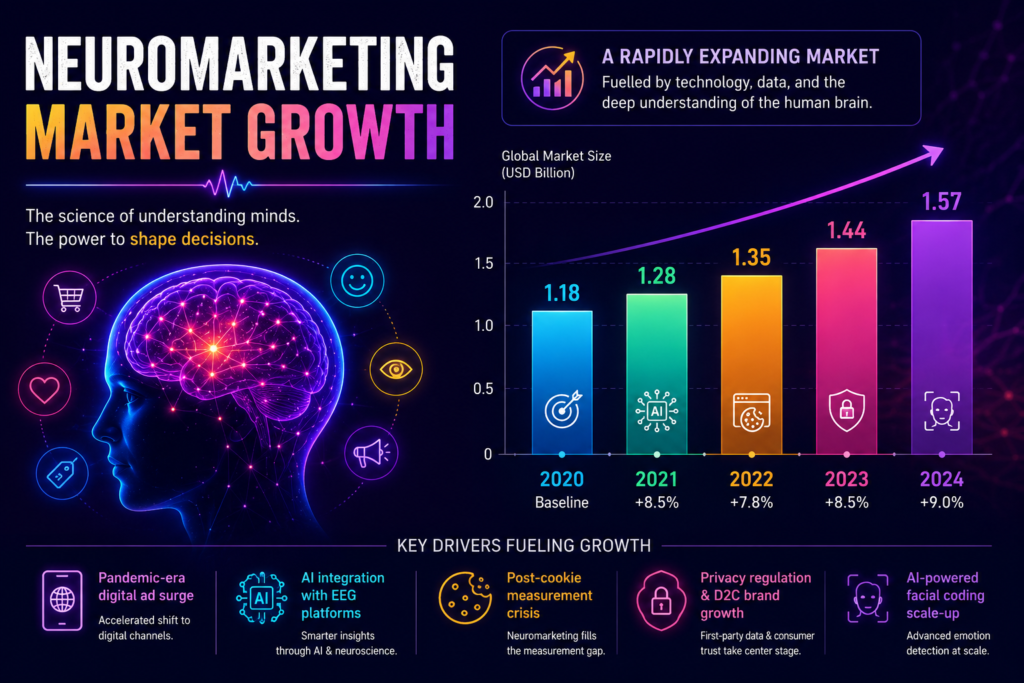
The global neuromarketing market stood at USD 1.57 billion in 2024. It is projected to reach USD 3.38 billion by 2033, growing at a CAGR of 8.9%. By 2025, the market is expected to cross USD 1.71 billion, reaching USD 2.62 billion by 2030 at a CAGR of 8.89%.
Conclusion
Neuromarketing answers the oldest and most expensive problem in marketing: the gap between what consumers say and what they actually do. Traditional methods capture conscious opinions filtered by social desirability, recall bias, and limited self-awareness. Neuromarketing bypasses all of that. It goes directly to the brain, the eyes, and the body’s involuntary responses. As the market grows toward USD 3.38 billion by 2033, brands of every size now access tools once available only to the largest research budgets. The question is no longer whether neuromarketing is valid. The question is how long a brand can afford to make decisions without it.
Leave a Reply