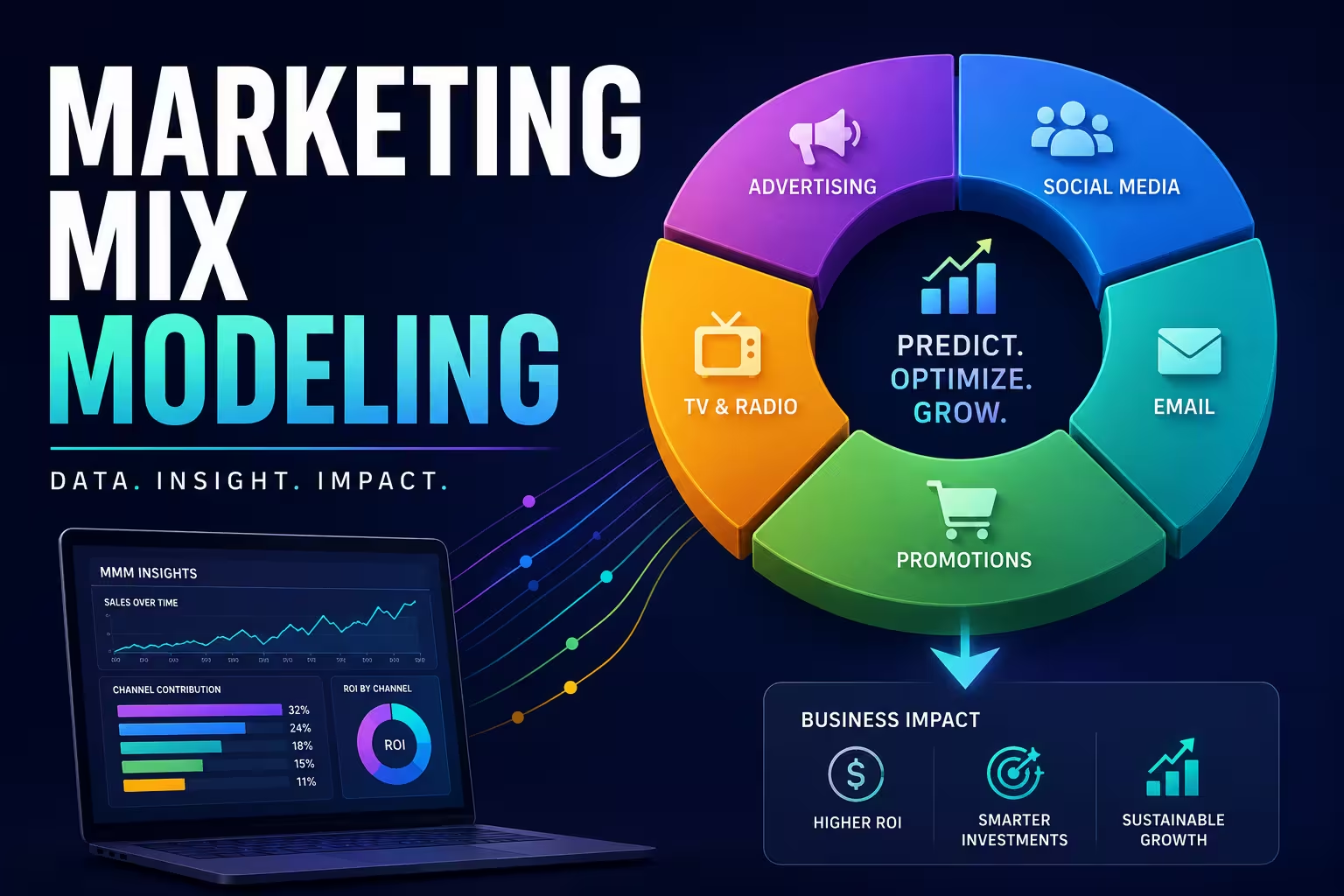

Philip Kotler, widely regarded as the father of modern marketing, framed the foundation of marketing effectiveness around the concept of the marketing mix, commonly known as the 4Ps: Product, Price, Place, and Promotion. Marketing Mix Modeling (MMM) builds on this framework by using statistical regression analysis to measure the contribution of each marketing input to a business outcome, typically sales or revenue.
The formal academic definition positions MMM as an econometric technique that isolates the effect of each marketing variable on business performance while controlling for external factors such as seasonality, economic conditions, and competitive activity. It was first applied at large scale by Nielsen and IRI in the 1990s for FMCG brands and has since expanded across industries.
Think of Marketing Mix Modeling like a recipe audit. Imagine you run a biryani restaurant and you spend money on Instagram ads, Google ads, newspaper inserts, and a loyalty app. Your sales go up. But which ingredient actually cooked the result? MMM is the tool that tells you: Instagram contributed 40%, Google 30%, the newspaper insert 5%, and the loyalty app 25%. Now you know where to add more and where to cut.
In short, MMM answers the question: “Of everything I spent, what actually worked?”
Success Story: boAt Lifestyle (India)

boAt, the Indian audio and wearables brand founded in 2016, scaled aggressively across digital and retail channels between 2020 and 2023. Facing growing competition from Noise and Boat rival brands, the marketing team adopted marketing mix modeling to evaluate spend across YouTube pre-rolls, influencer partnerships, Amazon ads, and offline retail promotions.
MMM revealed that influencer content on Instagram had a significantly higher return on ad spend (ROAS) than YouTube pre-rolls for its 18-24 age demographic. The brand reallocated budget accordingly and reported a 35% increase in revenue efficiency in FY2022-23. boAt’s ability to prioritise performance channels using data rather than intuition helped it maintain its position as India’s top audio brand by volume.
Failure Story: Byju’s Aggressive Spend Without MMM

Byju’s, the edtech unicorn founded in 2011 but that reached its aggressive expansion phase post-2019, spent heavily across television, celebrity endorsements (including Lionel Messi), digital campaigns, and sponsorships including the Indian cricket team jersey. The brand did not apply robust marketing mix modeling to track which channels were actually converting learners versus which were merely generating visibility.
Reports from 2022 and 2023 indicated that Byju’s was spending nearly 30 to 40 paise to acquire every rupee of revenue. The absence of MMM-led decision making meant budget was funnelled into high-visibility, low-conversion placements. The company’s financial distress between 2023 and 2024 was partly attributed to uncontrolled and inefficient marketing expenditure. This is a textbook example of what happens when a brand confuses reach with return.
MMM Adoption and Market Growth
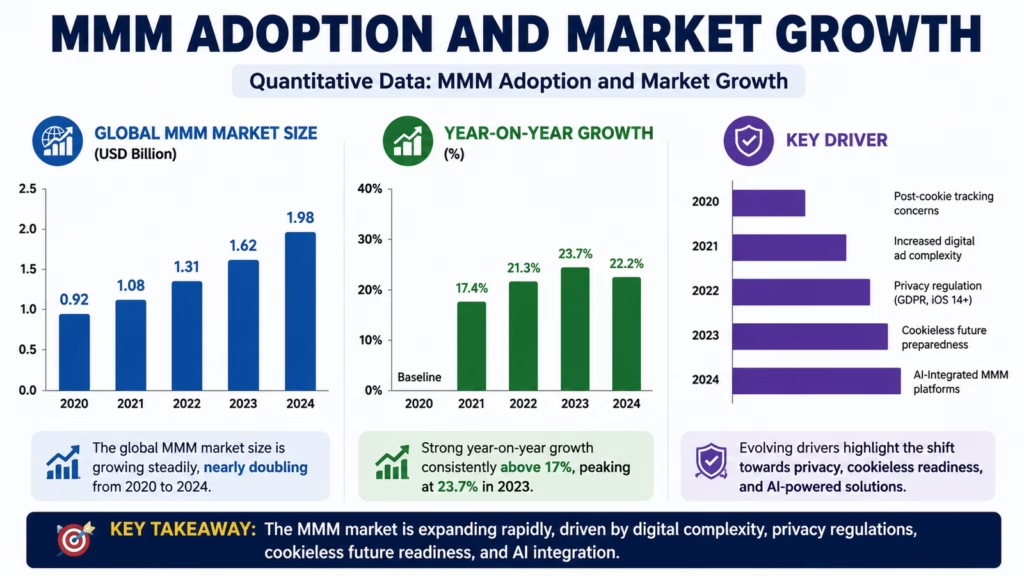
According to a 2023 Nielsen Annual Marketing Report, 64% of global marketers said they plan to increase their investment in MMM over the next two years, citing privacy-related limitations on digital tracking as the primary reason.
Why MMM Is Coming Back Stronger
MMM was considered old-fashioned for a period when digital marketing promised pixel-level attribution. You could see exactly which ad a user clicked before buying. However, the rollout of Apple’s App Tracking Transparency in 2021 and Google’s phaseout of third-party cookies changed that landscape permanently.
Digital attribution models began breaking down. Multi-touch attribution (MTA) could no longer stitch together complete user journeys. Brands that relied entirely on last-click or platform-reported ROAS started noticing that their numbers did not match actual revenue growth.
MMM does not require cookies or user-level data. It works at an aggregate level, using historical data across time periods. This makes it both privacy-compliant and reliable in a world where individual tracking is becoming increasingly restricted. Companies like Meta, Google, and Spotify have all released their own open-source MMM tools (Robyn by Meta, Meridian by Google) to help advertisers rebuild their measurement frameworks.
Where Most Brands Get MMM Wrong
The most common mistake is treating MMM as a one-time exercise rather than a continuous measurement practice. Running MMM once a year and applying those insights for the next 12 months ignores the fact that media efficiency changes with market conditions, creative fatigue, and competitor activity.
The second mistake is underestimating the data quality requirement. MMM outputs are only as reliable as the historical data fed into the model. Brands that have inconsistent sales data, fragmented media reporting, or poor tagging of offline spend tend to get inaccurate outputs and draw wrong conclusions.
The third mistake is siloing MMM within the analytics team without integrating its findings into actual budget planning conversations. Insights that do not reach the decision-makers who control the media budget serve no purpose.
Conclusion
Marketing Mix Modeling is not a nostalgic throwback to pre-digital marketing. It is the most credible, scalable, and privacy-compliant way for brands to understand what their marketing budget is actually doing. In an era where digital tracking is being curtailed, consumer journeys are non-linear, and CFOs are demanding proof of marketing ROI, MMM provides a structured and statistically sound answer. Brands that integrate MMM into their regular planning cycles will consistently outperform those that rely on platform-reported metrics or gut-driven budget allocation.
Leave a Reply